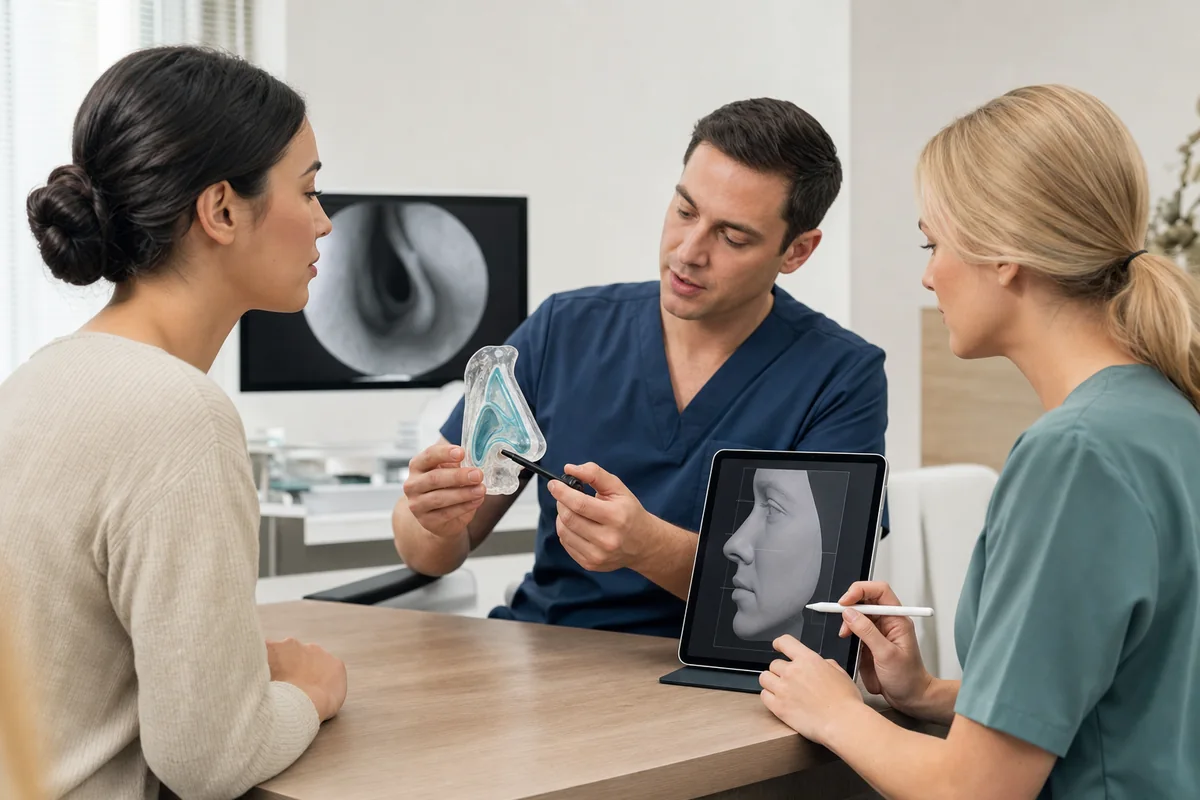
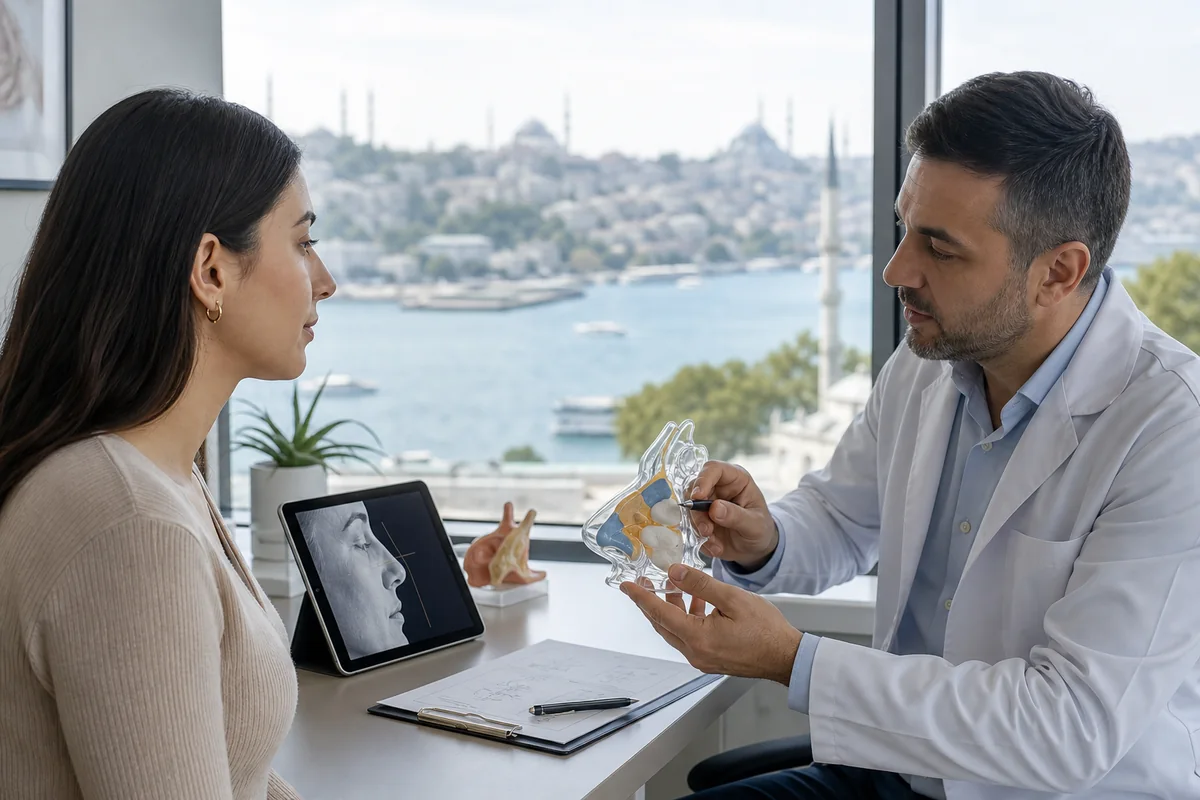
How Should You Choose a Rhinoplasty Surgeon in Turkey?
Choose with verifiable evidence, not a “best rhinoplasty surgeon” list. Confirm the surgeon’s medical and surgical specialty credentials, experience relevant to your type of case, and whether the consultation assesses nasal appearance, support and breathing together. Before committing, identify the licensed surgical facility, anaesthesia plan, complication pathway, full written quote and follow-up arrangements after you return home.
ENT and plastic surgery are different training pathways, but the specialty label alone cannot predict an individual result. The safer comparison is surgeon-specific: training, clinical process, honest risk communication and continuity of care.
ENT Surgeon or Plastic Surgeon for Rhinoplasty?
An ENT (otolaryngology–head and neck surgery) specialist is trained to assess the nose and upper airway, including the septum, turbinates and nasal valves. A plastic surgeon is trained in reconstructive and aesthetic surgery, including facial soft tissue, grafting and proportion. Surgeons from either background may develop focused rhinoplasty experience.
Do not assume that one specialty is automatically superior. Ask how the individual surgeon evaluates your concern, which parts of the operation they perform, and how their training relates to primary, functional or revision rhinoplasty. If obstruction or impaired breathing is part of the problem, the assessment should explicitly include the internal airway as well as the external nose.
Eight Checks Before You Book
1. Verify identity, registration and specialty
Match the surgeon’s name across the clinic website, professional profiles and official documents. Ask which authority recognises the surgical specialty in the country where the operation will take place. A social-media title, advertising badge or “international certificate” is not a substitute for a medical degree and recognised specialty credential.
2. Compare experience relevant to your case
Primary rhinoplasty, revision surgery, a thick-skinned nose and a case with nasal-valve or septal problems are not interchangeable. Ask for an explanation of experience with cases that are clinically comparable to yours. A raw operation count is less useful than understanding the case mix, role of the surgeon and follow-up of outcomes.
3. Expect an internal and external nasal assessment
A useful consultation should cover facial proportions, skin, nasal bones and cartilage, tip support and previous surgery. It should also ask about obstruction, trauma, allergies, prior nasal treatment and breathing. Photographs or video can support a preliminary review, but final suitability and the operative plan require a clinical examination.
4. Confirm the facility and anaesthesia plan
Ask for the name of the licensed facility before paying a deposit. Confirm who provides anaesthesia, what pre-operative tests are required, where early recovery occurs and how an unexpected hospital need would be handled. Do not rely on a package description that identifies only a hotel or transfer.
5. Discuss risks, limits and alternatives
Rhinoplasty is not risk-free. The discussion should cover bleeding, infection, anaesthesia risks, scarring, asymmetry, altered sensation, persistent or new breathing problems, dissatisfaction and possible revision. The surgeon should explain what may not be achievable for your anatomy and whether observation or a different treatment is a reasonable alternative.
6. Get complication ownership in writing
Ask who you contact day and night during the early postoperative period, where you would be examined if a problem occurs, and which costs are or are not included. Also ask what happens after you leave Turkey: who reviews photographs, how urgent symptoms are triaged and whether local medical care might be required.
7. Require a written aftercare and travel plan
The plan should state the in-person examination, operation, early checks, wound or splint review and the criteria used to clear travel. Flight timing cannot be safely chosen from a universal online timetable; it depends on the procedure, recovery and individual risk. Cosmetic surgery abroad should be treated as medical care, not combined with a holiday itinerary.
8. Compare the full written quote
Confirm what the price includes: surgeon, facility, anaesthesia, tests, medicines, postoperative checks, possible extra nights and the policy for complications or revision. Price alone does not establish quality, and a low headline figure may omit clinically important parts of care.
Red Flags When Comparing Rhinoplasty Clinics
- A coordinator will sell a date or package but the operating surgeon will not consult you
- “Guaranteed,” “risk-free,” “scarless” or universally “natural” results
- Pressure to pay immediately or a changing surgeon/facility after payment
- No clear answer about anaesthesia, emergency support or complication management
- Only filtered social-media images, without discussion of comparable anatomy and limitations
- A fixed return-flight promise before examination
- No written follow-up pathway after you return home
Questions to Ask During the Consultation
- What are your recognised medical and surgical specialty credentials?
- How does your experience relate to my primary, functional or revision case?
- Will you assess my septum, nasal valves and breathing as well as appearance?
- Which licensed facility and anaesthesia team will be used?
- What realistic changes and limitations do you see in my anatomy?
- What are the material risks, alternatives and signs that need urgent review?
- Who manages complications in Turkey and after I travel home?
- What does the full quote include, and what could create an additional cost?
About Op. Dr. Hüseyin Arslan
Op. Dr. Hüseyin Arslan practises in Şişli, Istanbul and is an ENT and Head and Neck Surgery specialist. His public physician profile lists his Ege University medical education and Ministry of Health-recognised specialist credential. His rhinoplasty assessment considers external shape, internal support and breathing; an online review is preliminary and does not replace examination.
Use the same checklist for this practice as for any other surgeon. Verify the physician profile, ask about the facility and anaesthesia for your proposed operation, and request a written risk, quote and follow-up plan before deciding.
The Decision in One Sentence
The right rhinoplasty surgeon in Turkey is not established by a ranking page, specialty label or price. It is the surgeon whose identity and training you can verify, whose experience matches the case, and whose clinical assessment, facility, risk management and long-term follow-up are explained clearly before payment or travel.