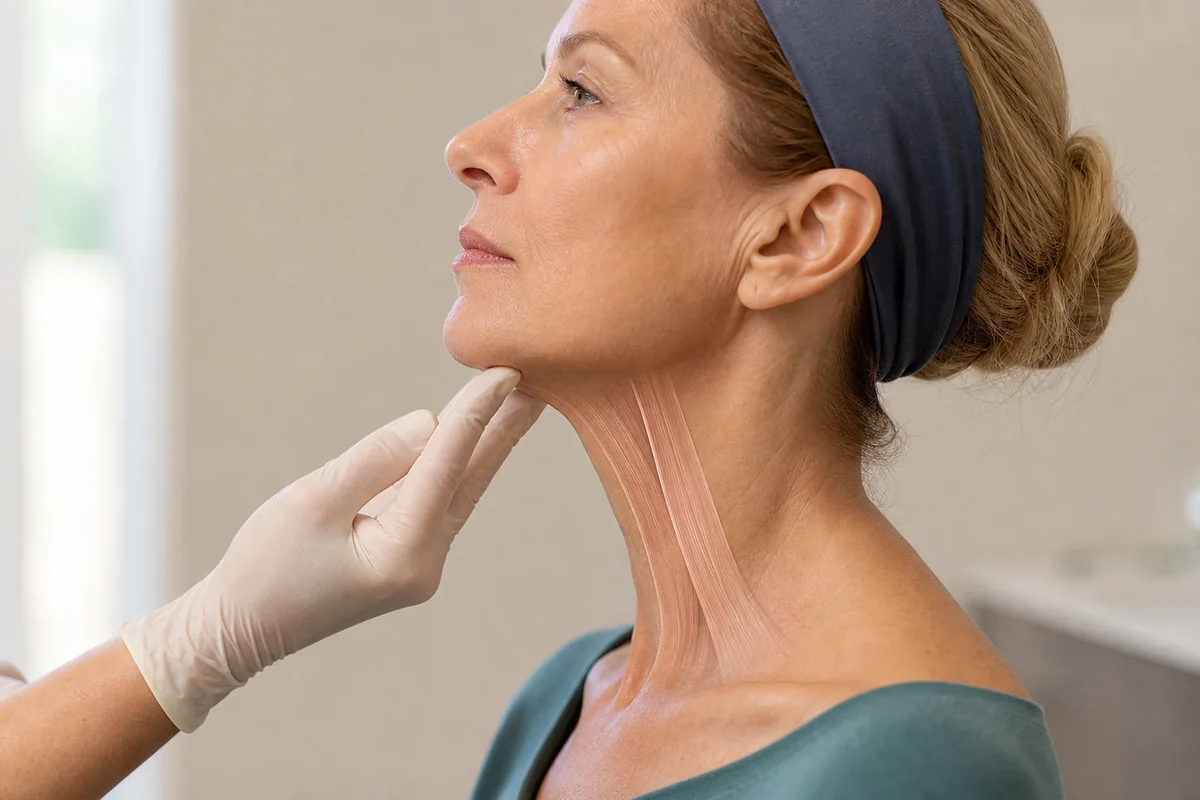
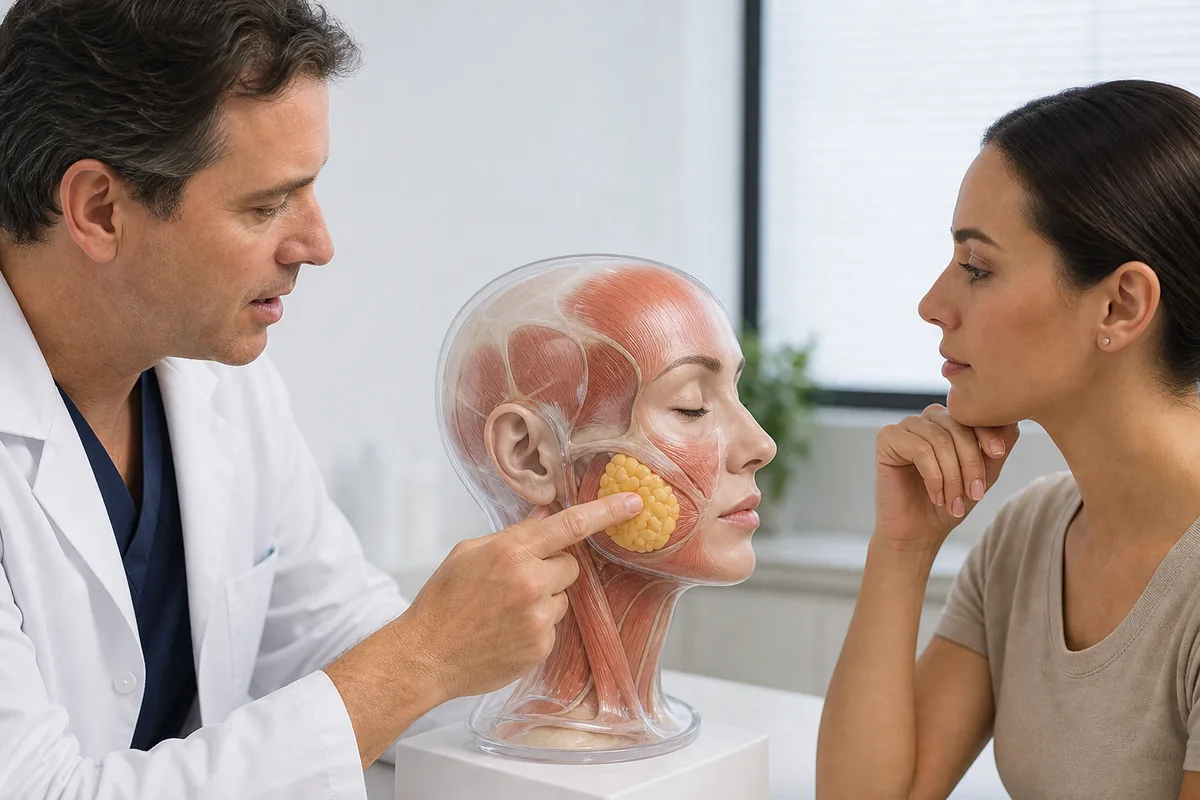
The platysma is a thin muscle directly beneath the skin across the front and sides of the neck, extending from below the jaw toward the collarbone region. Laxity or midline separation can contribute to visible neck bands and reduced jaw-neck definition.
What is the platysma?
The platysma is a thin muscle immediately beneath the skin across the front and sides of the neck, extending from below the jaw towards the collarbone region. Ageing, inherited anatomy, skin laxity and separation of the muscle near the midline may contribute to visible vertical platysma bands. The platysma is not the only cause of submental fullness: skin, superficial and deep fat, chin projection, salivary glands and muscle anatomy should be assessed together.
What is platysmaplasty?
Platysmaplasty is a general term for surgical steps that reshape the platysma and address selected bands. The muscle may be joined in the midline, specific bands may be treated, or a different lateral-support plan may be used. The operation is not identical for everyone; platysmaplasty, liposuction and deep-plane work are not interchangeable labels.
Finding being assessed
Possible approach
Important limitation
Superficial submental fat with good skin elasticity
Liposuction in selected cases
Does not by itself correct excess skin or muscle bands
Visible platysma bands
Surgery directed at the platysma
The cause and neck anatomy require examination
Excess skin with lower-face laxity
Neck lift, sometimes with a facelift
Incision, scar and recovery scope may increase
A small chin or deep-neck fullness
Separate assessment of the chin and deeper structures
Not every fullness is removable fat
Who may be a candidate?
People with realistic goals, health compatible with surgery and concern about bands, excess skin or the submental contour may be assessed. Smoking, bleeding or clotting risk, uncontrolled illness, impaired wound healing and previous face or neck surgery can change the plan. Photographs can support an initial discussion, but examination is needed to distinguish skin, muscle, fat and deeper anatomy.
Risks and limits of the evidence
Neck lift and platysmaplasty are not risk-free. Possible complications include bleeding or haematoma, infection, fluid collection, unfavourable scarring, asymmetry, prolonged swelling, altered sensation, skin-healing problems, nerve injury that may affect lower-lip movement and possible revision. A 2025 systematic review pooled different techniques and noted that standardised long-term comparisons remain limited. It therefore cannot establish one universally more natural, durable or safer technique.
Recovery and results
Dressings or a drain may be used depending on the operation. Swelling, bruising, tightness and altered sensation can occur; there is no responsible fixed date for returning to work, exercise or flying. Swelling may continue to settle over weeks or months and scars mature for longer. Ageing continues, and durability varies with tissue, technique, healing and lifestyle. A specific result cannot be guaranteed.
Questions to ask the surgeon
Is my contour concern mainly skin, fat, platysma, chin projection or a deeper neck structure?
Which parts of the plan are platysmaplasty, liposuction, neck lift or facelift?
Where are the incisions, and what are the anaesthesia, licensed-facility and emergency plans?
What are my personal risks, alternatives and likelihood of further surgery?
How will wound review, follow-up and travel clearance be documented?
This page provides general information. An individual recommendation requires medical history and examination.
Related questions
What is platysmaplasty?
Platysmaplasty is a general term for surgical steps that reshape or tighten the platysma muscle and its bands. It may be performed alone or as part of a neck or face-lift plan; the scope depends on the skin, fat, muscle anatomy and overall health assessment.
What are the risks of platysmaplasty and neck lift?
These operations are not risk-free. Bleeding or haematoma, infection, scarring, asymmetry, prolonged swelling, altered sensation, skin-healing problems, nerve injury and possible revision should be discussed. Personal risk requires medical-history review and examination.
Medical sources
These sources support general medical information and do not replace an individual assessment.