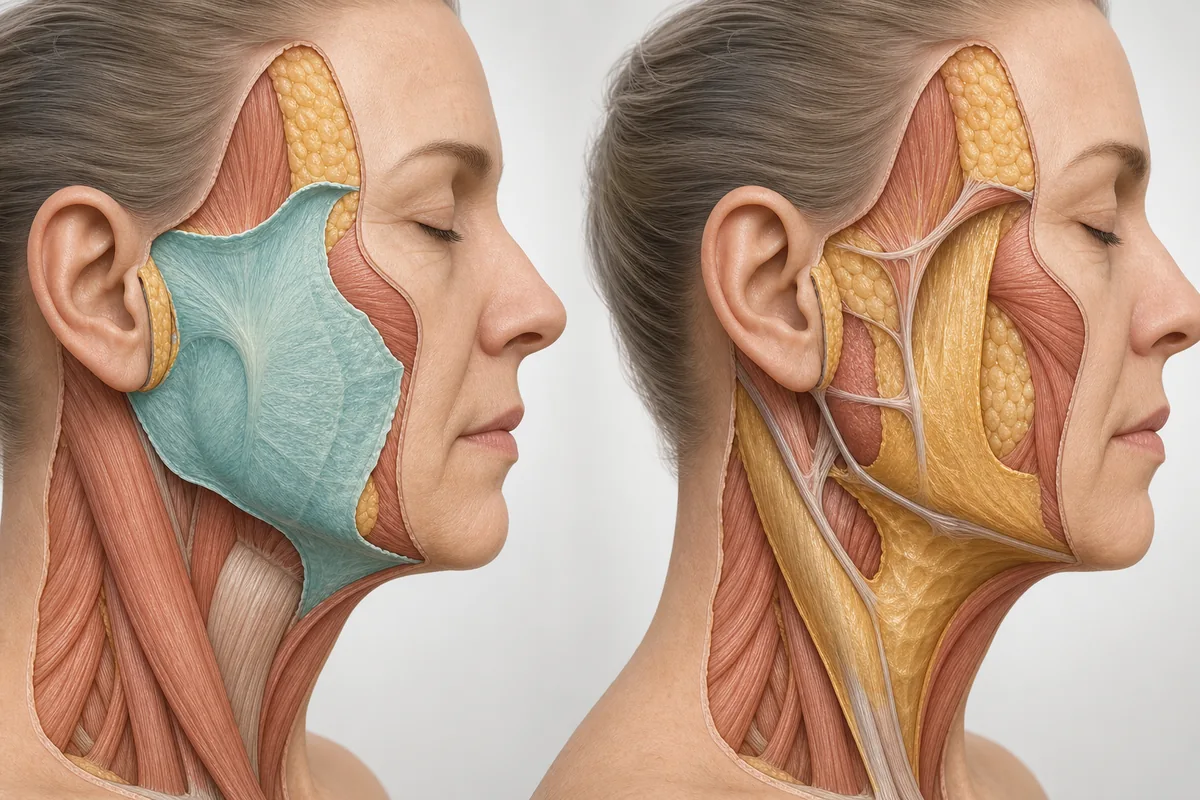
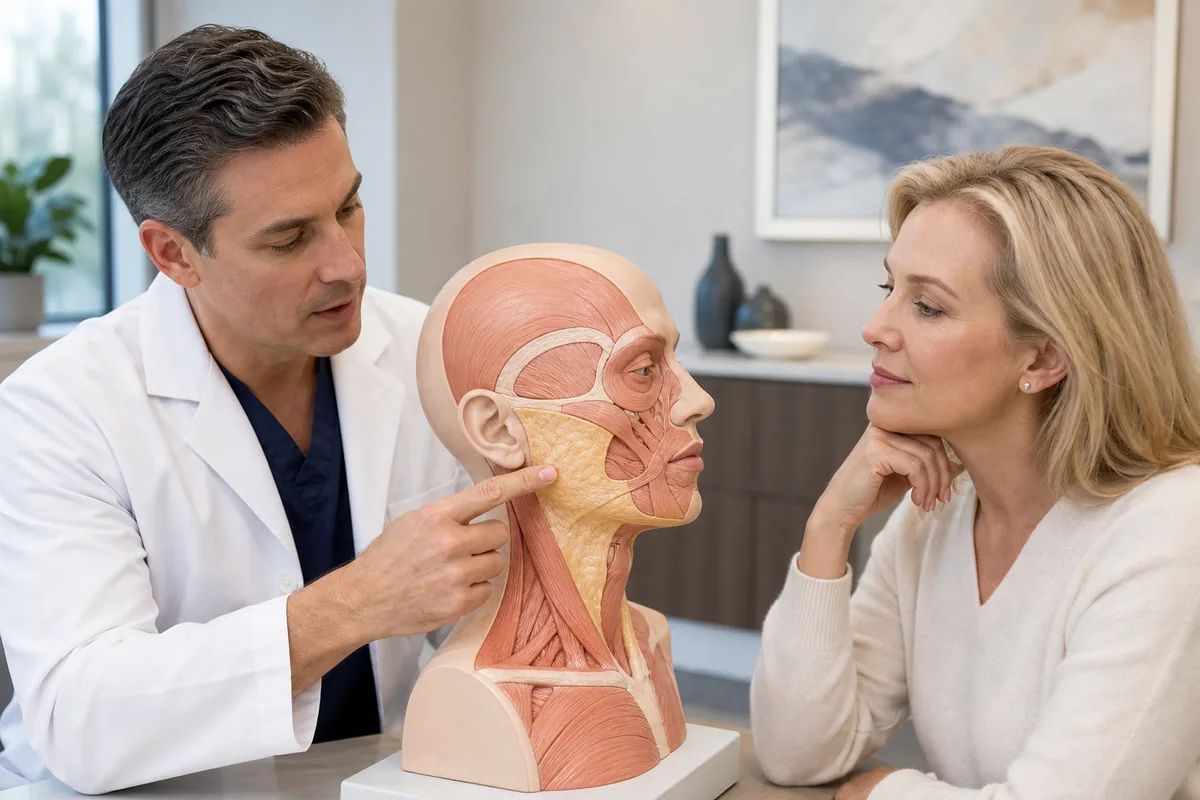
What is the platysma?
The platysma is a thin muscle just beneath the skin across the front and sides of the neck. Age-related laxity or visible bands can affect the neck and jawline and may be assessed separately when planning face and neck surgery.
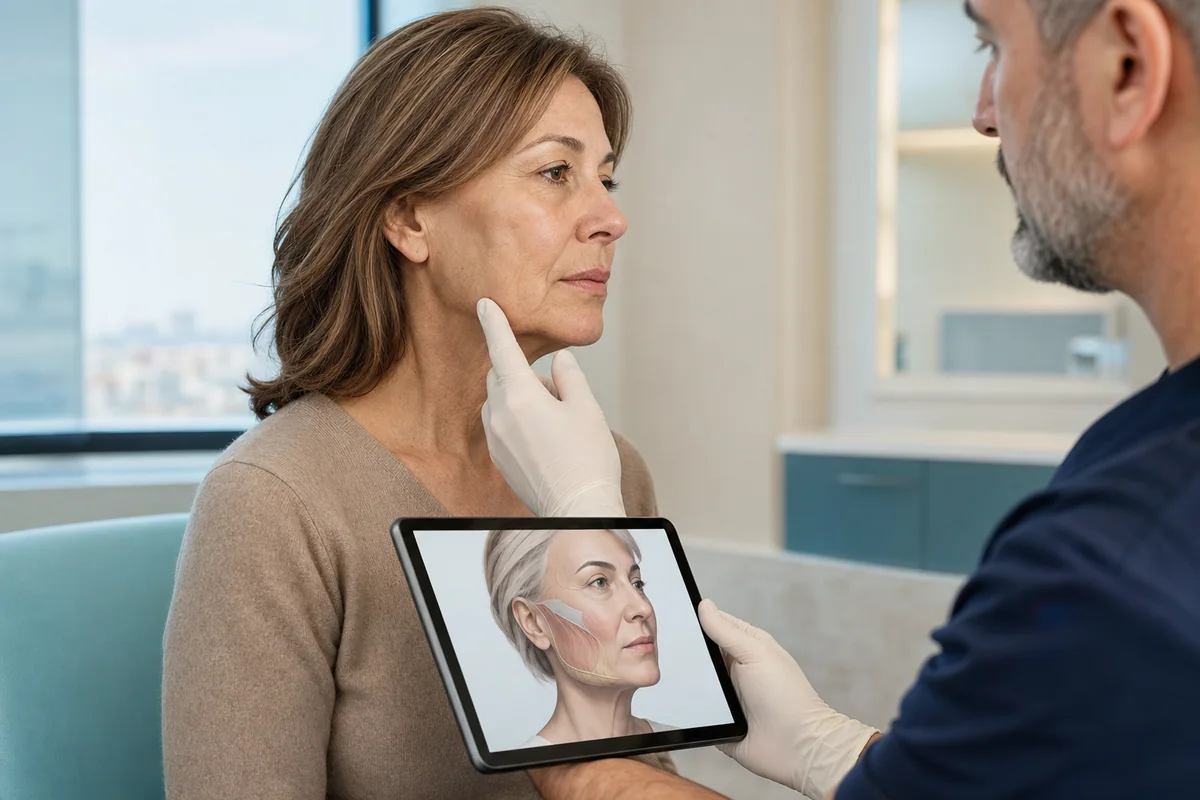
Illustrative image · AI-generated
Direct answer
A deep plane facelift is one of several facelift approaches that enters below the SMAS in selected areas, may release retaining ligaments and repositions skin with deeper tissues. It is not proven to be the best technique for every patient; suitability depends on anatomy, goals, health, risk and examination.
A deep plane facelift is one of several approaches that works in selected planes beneath the superficial musculo-aponeurotic system (SMAS). The extent of ligament release and the vectors of tissue repositioning vary with the surgical plan. Comparative evidence does not establish one technique as superior for every patient, so candidacy begins with anatomy and risk assessment rather than a technique label.
There is no evidence-based rigid age cutoff. The distribution of laxity, skin and neck anatomy, overall health, personal goals, anaesthetic risk and healing capacity matter more than chronological age alone.
Midface descent: Cheeks that have migrated downward, deepening the nasolabial folds and creating a fatigued or drawn facial expression.
Pronounced jowling: Tissue accumulation along the jawline that disrupts lower face contour. Deep plane directly addresses the retaining ligaments that contribute to jowl formation.
Loss of neck-chin angle: Platysmal banding or blurring of the neck-lower face junction. A neck component (platysmaplasty) can be incorporated when needed.
Relatively preserved skin elasticity: The skin must be of sufficient quality to tolerate the mechanical forces of the lift.
Previous facelift: Revision surgery can be more complex because of altered anatomy and scar tissue. No approach, including deep plane, is automatically advantageous; prior operative details and an in-person assessment are important.
Candidates must be able to safely undergo general anesthesia or deep sedation: controlled cardiovascular status, normal coagulation values, smoking cessation (active smoking impairs healing), and careful evaluation of diabetes and connective tissue disorders.
Facial anatomy varies substantially between individuals: bone structure, fat compartment distribution, skin thickness, and elasticity all directly influence outcomes. A one-technique-fits-all approach is inadequate. Identifying the right candidate and building a realistic expectations map requires a thorough in-person examination with a surgeon experienced in facial plastic surgery.
Being a possible candidate does not establish that a particular surgeon, facility or travel plan is appropriate. Before arranging surgery in Turkey, verify the operating surgeon’s recognised specialty credential, relevant training, comparable face and neck cases, current operative privileges, licensed facility, anaesthesia professional, complication pathway, full written quote and cross-border follow-up.
Ask whether the proposed facelift includes a separate neck procedure, platysma work, fat treatment, eyelid or brow surgery. Each added step needs its own indication, risks, anaesthesia impact and fee. Combining procedures is not automatically safer or more efficient.
There is no universal safe number of days to stay in Istanbul or a guaranteed flight-clearance day. The plan should depend on the operation, early examination, wound and swelling findings, medical history, flight length and individual recovery.
Deep plane surgery is one option for selected patients. Expected change, incision planning, anaesthesia, haematoma, nerve injury, scarring, asymmetry and possible revision should be discussed in person. A photo-based remote review can provide preliminary guidance only; candidacy and technique are confirmed after examination in Istanbul.
The platysma is a thin muscle just beneath the skin across the front and sides of the neck. Age-related laxity or visible bands can affect the neck and jawline and may be assessed separately when planning face and neck surgery.
Current comparative evidence does not establish deep plane as universally safer, more natural or longer-lasting than SMAS techniques. The relevant operation depends on examined anatomy, the required face and neck steps, risk profile and the surgeon’s verified experience.
Verify the operating surgeon’s identity, recognised specialty credential, relevant training, comparable face and neck cases, current operative privileges, licensed facility, anaesthesia professional, complication pathway, itemised quote and written follow-up after you return home.
No. Jowls, platysma bands, submental fat, skin laxity, glands and chin support are assessed separately. Any neck lift or platysmaplasty step should have its own indication, incision, risks, anaesthesia impact and fee in the written plan.
There is no universal safe stay or flight day. The operation, early examination, wound and swelling findings, medical history, flight length and individual recovery should determine travel clearance and follow-up.
These sources support general medical information and do not replace an individual assessment.
Contact us for more information or to schedule an appointment about this topic.
Facelift in Istanbul: assessment, technique and recoveryResponsible publisher:

ENT Specialist Surgeon
Combines ENT expertise with nasal function, facial anatomy and aesthetic surgical planning.
Personal preliminary review
Share your concern and photos if available. A preliminary review provides general guidance; the final plan requires an examination.