Deep Plane Facelift in Istanbul — Direct Answer
A deep plane facelift in Istanbul should be compared as a complete care plan, not as a technique name or package price. Verify the operating surgeon’s identity, recognised specialty credentials, relevant training, experience with comparable face and neck cases, the licensed facility, anaesthesia provider, material risks, complication pathway, full written quote and follow-up after you return home.
“Deep plane” describes parts of the dissection and ligament-release strategy. It does not by itself prove that an operation is safer, more natural or longer-lasting for a particular patient.
The Eight Checks to Complete Before Booking
| Check | Evidence to request | Warning sign |
|---|
| Operating surgeon | Full name, recognised specialty credential and direct consultation | Only a sales coordinator is available |
| Relevant experience | Comparable face and neck cases with consistent views and follow-up | Technique claims without case evidence |
| Proposed operation | Written indication, incision, dissection and neck plan | “Deep plane” used without explaining the actual steps |
| Surgical facility | Facility name, licence and planned level of care | Facility disclosed only after payment |
| Anaesthesia | Named anaesthesia professional and monitoring plan | Anaesthesia described as risk-free |
| Risks and complications | Personal risk discussion and urgent pathway | Guarantees or dismissal of haematoma, nerve or healing risks |
| Quote | Surgeon, facility, anaesthesia, tests, medicines and follow-up itemised | Headline package price with important exclusions |
| Cross-border aftercare | In-person checks, travel clearance, emergency contact and home-country follow-up | A fixed flight day promised before examination |
Deep Plane, SMAS and Neck Lift Are Not Interchangeable Labels
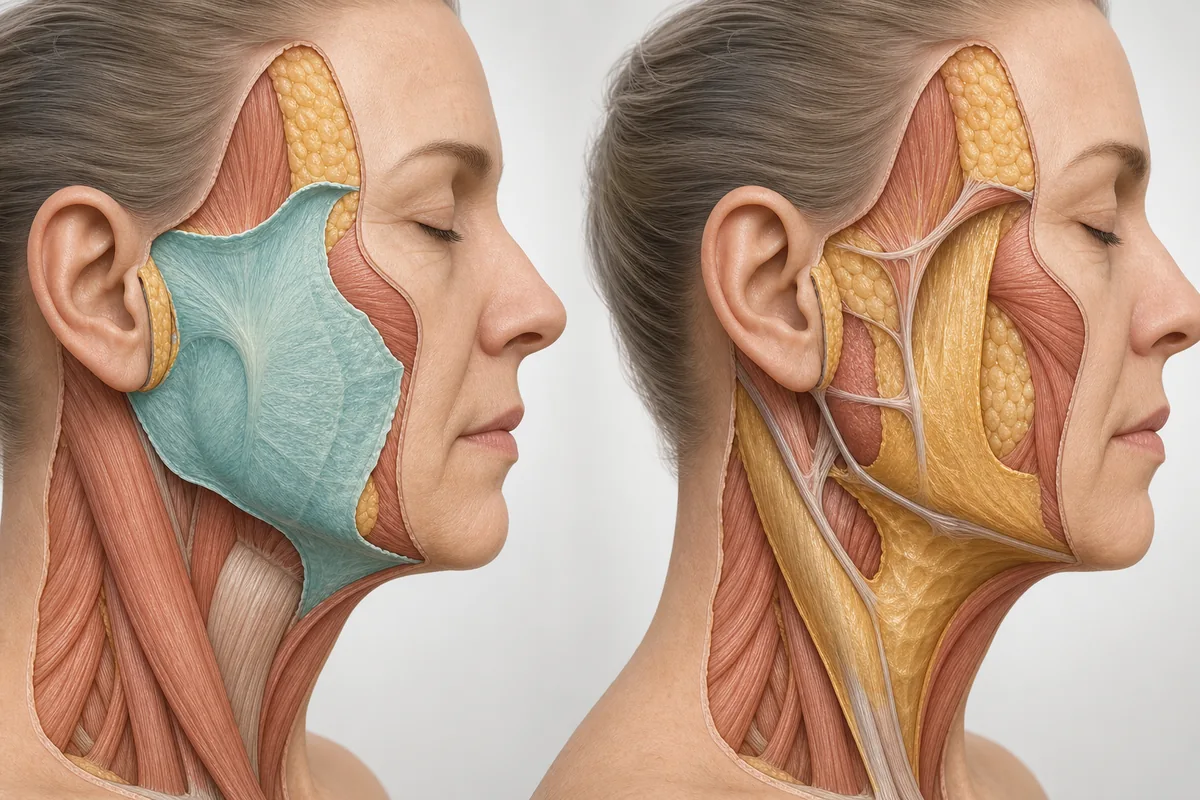
The SMAS is a supporting layer between the facial muscles and skin. SMAS facelift methods may fold, tighten, excise or reposition this layer. Deep plane approaches enter below the SMAS in selected areas and may release retaining ligaments before repositioning a composite of skin and deeper tissue.
These are technique families rather than a simple “basic versus advanced” ranking. Published comparative reviews do not establish deep plane as universally safer, more natural or more durable than SMAS techniques. The relevant question is which operation addresses the examined anatomy with an acceptable risk profile in the hands of the proposed surgeon.
A facelift does not automatically include every neck step. Jowls, platysma bands, submental fat, gland position, skin laxity and chin support are assessed separately. If a neck lift or platysmaplasty is proposed, its indication, incision, added anaesthesia time, risks and fee should appear in the written plan.
How to Verify the Surgeon Without Relying on Marketing
Specialty titles describe a training pathway; they do not prove an individual result or experience with a specific operation. ENT and Head & Neck Surgery, plastic surgery and facial plastic surgery have different training routes across countries. Verify the exact credential rather than treating any label as an automatic quality ranking.
Op. Dr. Hüseyin Arslan’s documented specialty is Otorhinolaryngology (ENT) and Head & Neck Surgery. That credential should be assessed alongside the same procedure-specific evidence requested from any surgeon: relevant additional training, comparable cases, current operative privileges, the facility and anaesthesia team, complication ownership and written follow-up.
For photographs, request cases with anatomy and goals comparable to yours. Look for consistent lighting, distance, expression and angles, plus enough follow-up to distinguish early swelling from a settled result. Patient consent and privacy should be respected; social-media volume is not clinical evidence.
Facility, Anaesthesia and Complication Ownership
Ask where the operation will take place before paying a deposit. Confirm the licensed facility, who provides anaesthesia, the planned monitoring and whether an overnight stay or higher level of care may be needed. The word “clinic” does not tell you where surgery is performed.
Possible facelift risks include haematoma, infection, skin-healing problems, hair loss near incisions, visible or widened scars, asymmetry, altered sensation and temporary or, less commonly, permanent facial-nerve injury. Smoking, medicines, previous surgery, cardiovascular conditions, bleeding risk and individual anatomy can change the risk profile.
The written plan should identify who evaluates a suspected complication, where urgent treatment occurs, what costs may fall outside the original quote and how care continues after the patient leaves Turkey.
What a Facelift Quote in Turkey Should Include
There is no responsible single online price for every deep plane facelift. The quote changes with the actual face and neck plan, revision status, operating time, facility, anaesthesia, overnight care, tests, medicines and follow-up.
Request an itemised written quote covering:
- the operating surgeon and proposed procedure;
- facility and anaesthesia fees;
- pre-operative tests and consultations;
- hospital or overnight care, if planned;
- dressings, garments and prescribed medicines;
- scheduled in-person reviews;
- what happens financially and clinically if the plan changes;
- what is excluded, including hotel, transfers or treatment of complications.
Do not compare two prices until the proposed operations and inclusions are genuinely comparable. A lower quote is not proof of poor care, and a higher quote is not proof of expertise.
Recovery and Flying Home
Swelling, bruising, tightness, sensory change and fatigue vary with surgical scope and individual healing. Drains or dressings may be used, and different incision areas can have different review schedules. There is no universal day on which every patient is socially ready, fit for work or safe to fly.
International travel planning should include an early in-person review, wound and swelling assessment, criteria for removing any drains or sutures, an urgent contact route and a plan for follow-up at home. Flight length, mobility, medical history, complications and any combined procedures can alter the timetable. An online consultation can organise information, but it cannot confirm final candidacy or flight clearance.
Who May Be Considered — and Who Needs More Caution
Facelift assessment considers the source and distribution of facial and neck laxity, skin quality, prior procedures, scars, facial movement, general health, medicines, smoking and realistic goals. There is no evidence-based age alone that confirms or excludes candidacy.
More caution or postponement may be needed with uncontrolled medical conditions, active nicotine use, bleeding risk, unstable weight, unrealistic expectations or insufficient anatomical indication. Non-surgical options may be discussed for limited concerns, but they should not be presented as equivalent to surgery.
Questions to Ask During the Consultation
- What exact findings do you see in my midface, jawline and neck?
- Which surgical steps are proposed, and what will not be treated?
- Why is deep plane, a SMAS method or another plan appropriate for me?
- What recognised specialty and procedure-specific training can I verify?
- May I review comparable cases with consistent photography and meaningful follow-up?
- Where will surgery occur, and who will provide anaesthesia?
- What are the material risks in my case and your complication pathway?
- What does the written quote include and exclude?
- Which findings must be checked in person before confirming the plan?
- Who remains responsible for follow-up after I return home?
Decision Summary
Choose a deep plane facelift plan in Istanbul only after verifying the surgeon, comparable experience, facility, anaesthesia, risks, quote and cross-border aftercare. Technique terminology can help describe an operation, but it cannot replace examination or prove quality. A trustworthy consultation explains both why a proposed step may help and why another step may be unnecessary.