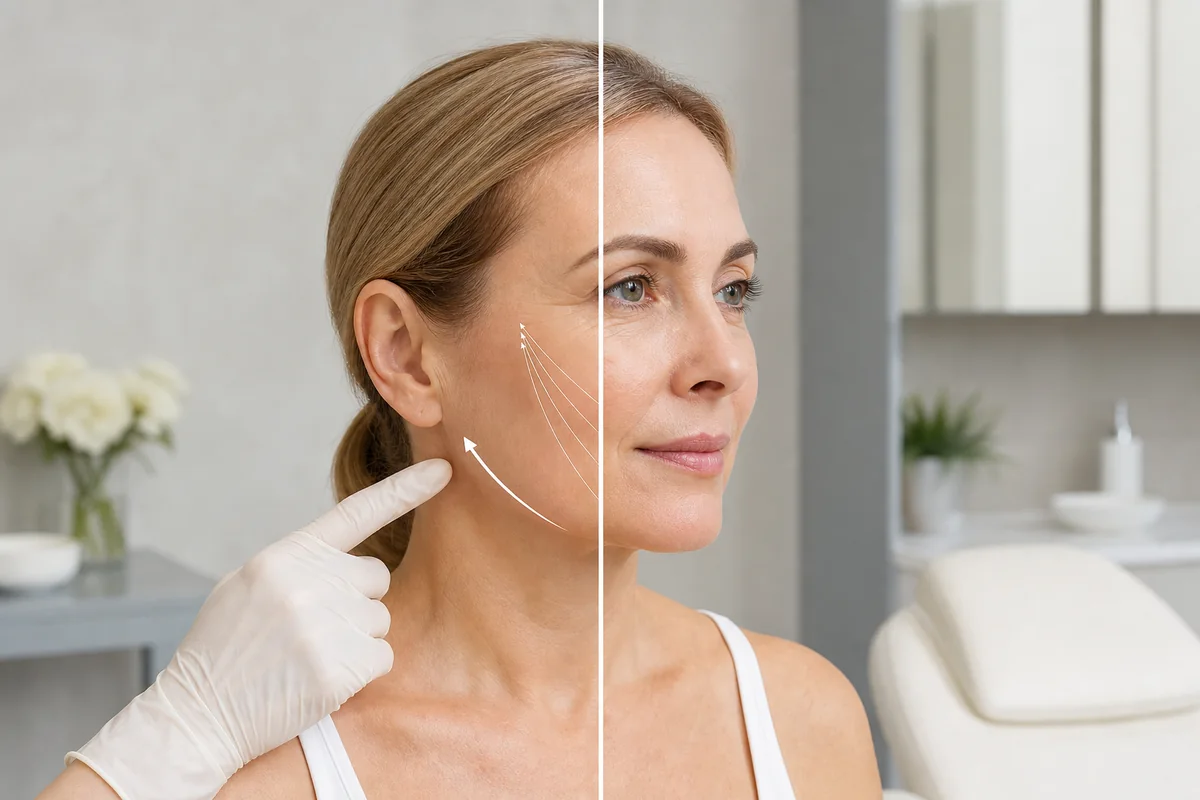
Facelift vs Thread Lift
When patients ask this question, what they usually mean is: can I get the best result with the least intervention? The honest answer: both procedures have genuine value when the right patient is matched to the right technique — and both disappoint when they are not.
What Is a Thread Lift?
A thread lift involves inserting barbed or smooth threads under the skin using fine needles, physically repositioning lax tissue upward. It is usually performed under local anaesthesia through small entry points, without the longer incisions of a surgical facelift.
Advantages: It is a more limited procedure and a shorter recovery is usually planned. It still carries risks such as thread extrusion, infection, pain, swelling and bruising, temporary difficulty opening the mouth and an unfavourable result; return to daily activity varies.
Limitations: The effect is temporary and its duration varies with thread type, tissue and the individual; it cannot remove excess skin — it only repositions existing tissue; significant laxity yields limited improvement; thread migration or asymmetry can occur.
In short: a thread lift is a reasonable choice for early-stage laxity in a patient with good skin quality seeking modest rejuvenation.
What Is a Surgical Facelift?
A facelift (rhytidectomy) involves incisions around the ears through which the deeper structural layers — the SMAS, or in deep plane technique the platysma and facial fat compartments — are repositioned rather than simply pulled. The goal is structural correction, not surface tension.
Deep Plane Technique: An approach that releases retaining ligaments in a deeper plane, particularly to address the midface. Comparative evidence does not establish deep plane surgery as more durable or more natural for every patient; the technique is chosen according to anatomy and goals.
Advantages: It can remove excess skin and reposition deeper tissues, so it may be considered for moderate to advanced laxity where threads are limited. How long the result lasts varies, and ageing continues.
Disadvantages: It requires general anaesthesia or sedation, incisions around the ears and a longer recovery. Surgical risks include bleeding, fluid accumulation, facial nerve injury, numbness, wound-healing problems and unfavourable scarring; the return-to-activity plan is individual.
Comparison Table
| Feature | Thread Lift | Surgical Facelift |
|---|
| Anaesthesia | Usually local | General anaesthesia / sedation |
| Incisions | Small entry points | Incisions around the ears |
| Recovery | Usually shorter; individual | Longer; individual |
| Duration of effect | Temporary; variable | Varies by individual; ageing continues |
| Removes excess skin? | No | Yes |
| Deep structural correction? | Limited | Yes |
| Laxity usually considered | Mild | Moderate to advanced |
Who Is a Candidate for Each?
Thread lift may be considered for: early, mild laxity; reasonably good skin quality; preference for a more limited procedure; acceptance of a temporary, modest change.
Surgical facelift may be considered for: moderate to advanced laxity; visible excess skin or platysmal banding; the goal of a more extensive correction; health status suitable for surgery.
Frequently Asked Questions
I had threads done and was disappointed. What now?
The concerns with the result and the current laxity are assessed in person first. The type and timing of previous threads are taken into account in surgical planning; not every patient needs surgery.
Will a facelift look obvious?
Appearance depends on facial anatomy, the actual surgical scope, incision placement and individual healing. A natural look is the aim but cannot be guaranteed; scarring and healing should be discussed in person.
Conclusion
Thread lift and surgical facelift are not competing options — they answer different needs. The right choice is determined by your degree of laxity, expectations, and overall health, assessed in person.